

By Team Cocoriko on Aug 20, 2026, 1:55:04 p.m.
What the best proposals have in common...
Every year, hundreds of consulting firms—in planning, management, engineering, communications, organizational development, or the environment—respond to requests for proposals (RFPs) that include a public consultation or stakeholder engagement component.
The majority offer similar approaches: surveys, workshops, public meetings, and online questionnaires. Yet, some proposals manage to stand out. Why? Because they clearly demonstrate how they will address the client's concrete challenges, rather than simply listing the tools they will use.
Start with the problem, not the technology
When an organization issues an RFP, it is rarely looking for a platform for its own sake. It is looking for a better way to consult, engage, and analyze results.
Depending on the project, the challenges can be numerous:
- Low participation from citizens or stakeholders
- Complex processes to administer
- Platforms that create friction for participants
- Manual analysis of hundreds of comments
- Issues related to bilingualism, accessibility, or transparency
A strong proposal identifies these pain points from the beginning and demonstrates how the proposed approach will solve them. Technology then becomes a means to achieve the client's objectives, rather than an end in itself.
Integrate your partner into your approach
A technology partner should not appear solely in an appendix or on a vendor list. When their contribution is truly strategic, they deserve to be integrated naturally throughout the proposal:
- In understanding the client's needs
- In the methodology
- In the description of deliverables
- In the execution schedule
- In the budget and division of responsibilities
This coherence demonstrates that the partnership is an integral part of how you deliver the mandate.
Give your partner a concrete role
The best proposals do not settle for displaying a logo or mentioning a collaboration. They explain precisely what each partner will carry out during the project.
For example:
- Platform setup
- Strategic guidance
- Outreach and promotion of consultations
- Technical support
- Analysis of results (both quantitative and qualitative)
- Report production
This precision increases the credibility of the entire team.
Clarify responsibilities
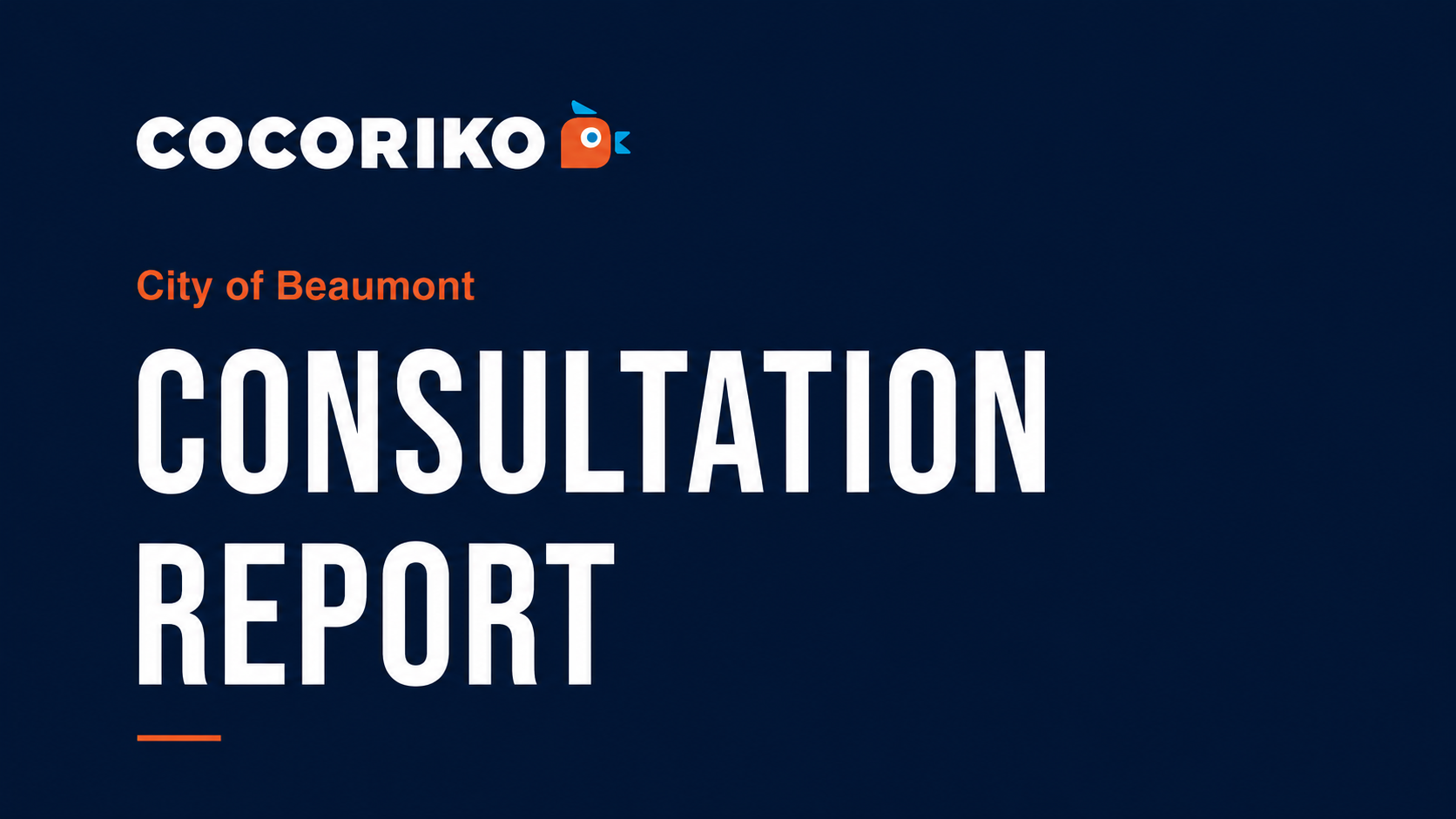
Clients want to know who is responsible for what. A clear division of labor between your firm and your partner reassures the evaluation committee and reduces gray areas during project execution.
For example:
- Your team leads strategy, facilitation, and client relations.
- Cocoriko provides the platform, guides the digital strategy, and supports the analysis of results.
This complementarity allows everyone to contribute according to their core expertise.
Focus on added value
Beyond feature lists, evaluators want to understand the concrete benefits of your approach. A specialized partner like Cocoriko can help:
- Simplify citizen or stakeholder participation
- Offer a bilingual experience on a single platform
- Improve accessibility and transparency
- Accelerate comment analysis using artificial intelligence
- Produce reports faster
- Reduce your team's administrative workload
When presented within the context of the mandate's goals, these advantages carry far more weight than basic technical specifications.
In summary
A technology partner does not win an RFP on their own. However, when seamlessly integrated into your methodology, they can significantly strengthen the credibility of your proposal.
Key takeaways:
- Always start with the client's challenges
- Demonstrate how your approach addresses them
- Give each partner a concrete role
- Clarify responsibilities
- Emphasize expected outcomes rather than software features
At Cocoriko, we regularly support consulting firms in preparing their bids. We can help you effectively integrate a public consultation strategy that fits naturally into your service offerings and helps strengthen your proposals.
Designing a park that reflects its future users: children aged 18 months to 5 years
Pointe-Claire is located in the West Island region of Montre …

Participatory budgeting: engage your community with Cocoriko
Participatory budgeting has become an interesting tool for b …
What is Community/Public Engagement? [Real-World Examples]
In its simplest terms, community engagement is about giving …